




Choosing stone

|

|
| Portland Stone swag | A swag being machined |
The term natural stone is a broad one covering a multitude of different types of stone which look very different and have different properties. Perhaps the most important thing to consider when thinking about using natural stone in a project is which type of stone to choose.
The first thing to think about is the position of the installation – is it outdoors? In which case a granite or harder limestone such as the Jura Beige or Blue might be more appropriate than a marble that could potentially erode more quickly, depending on its exposure to weather and pollution. A related consideration is the setting – if the project is an external one in Bath, then Bath Stone is probably the only type of stone that you will be allowed to use, whilst in parts of central London, Portland Stone may be required for architectural purposes, in other areas, or for monuments or artwork there may be more freedom to choose.
|
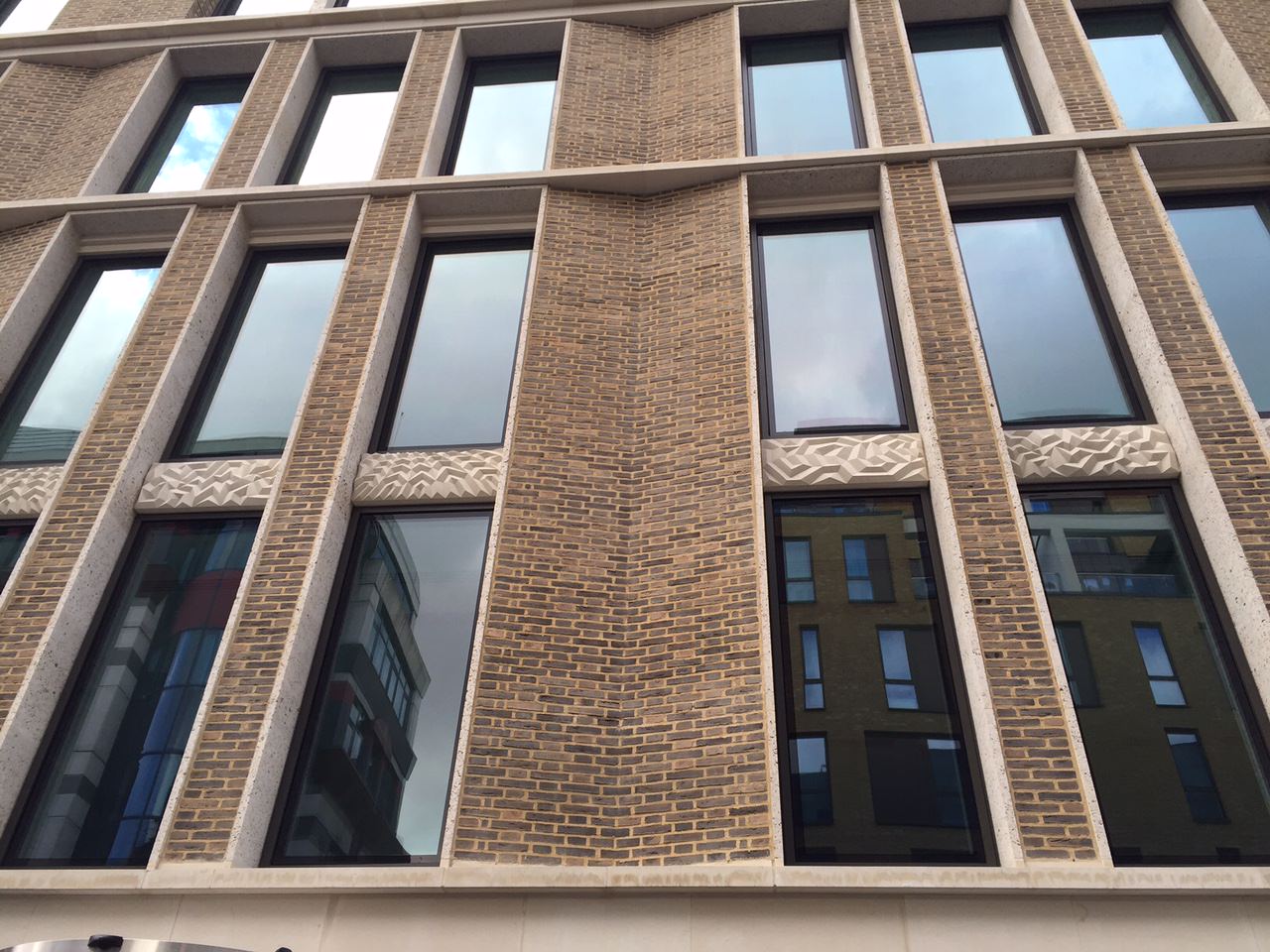
| Sasha Holzer wood panels reproduced in Portland Stone on the facade of 30 Broadwick Street |
If it is to be installed indoors what is the potential wear and tear? Will it be on the floor or used as a worktop, what will the cleaning regime be and is it likely to have food, wine or chemicals spilled on it on a daily basis?
|
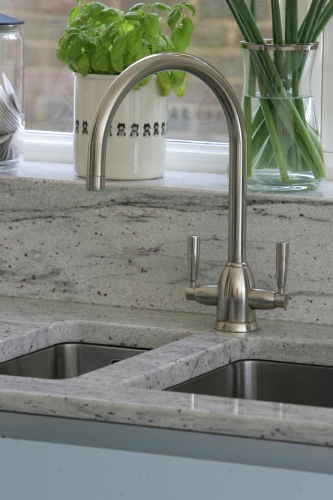
Granite worktop |

|
Bianco Lasa quartzite counter tops |
If it is for use as a work surface in a kitchen, then granite would be the obvious choice as this is extremely hard-wearing. Marble can be, and is, used for kitchen counter tops but it is more likely to be stained and etched by the acid in food, so more care is needed to prevent spillages and clean them up promptly. The future owner must also appreciate and like the fact that the counter top will wear and develop a patina, rather than staying pristine. It is for this reason that marble and the softer limestones are more often used in bathrooms and as internal floor tiles in areas where there is less traffic. Staircases and fireplaces are also often produced in marble or limestone, although granite is a good alternative where load bearing considerations are not a problem. Pools and spas often use marble or limestone, although care needs to be taken if they are used in locations that come into contact with water where too much chlorine or salt in the water could damage the stone over time.

|

|
| Arabescato marble staircase and floor with Nero Marquina waterjet cut border | Limestone pool surround with slate wall tiles |
The next consideration can be the look – does the client want a showstopper as a focal piece for the room? Heavily veined marbles and granites, or if budget permits, quartzite or onyx come in a stunning variety of patterns and colours which can have a wow factor. Book matching, where two slabs from the same block are used side by side so that the veins meet and mirror each other, is in vogue and can be used to striking effect.

|

|
| Black wave bathroom floor | Crema grey light marble bathroom |
Or is something more subtle called for to give a beautiful backdrop to a luxurious room? In this case limestones with small fossil inclusions, ’quieter’ marbles with less contrast in the veining, and subtly-speckled granites may be more suitable.
One of the major considerations for a natural stone installation is the stonemason that will fabricate the stone and install it. A good stonemason will be able to advise on choosing the right type of stone for the project and suggest alternatives that will fit the brief and budget. They will source stone from reputable quarries where the work force is employed ethically and the quality is right.
A modern stonemasonry factory should use a mix of the latest Computer Numerical Control (CNC) equipped machines for cutting and carving, combined with hand finishing where necessary for the project. Waterjet cutters are also essential for producing inlaid work precisely and at a reasonable cost.

|
CNC equipped stonemasonry machinery in stoneCIRCLE's factory |

|
A mason finishing a stone carving by hand |
Dealing with a UK stonemasonry company can help avoid misunderstandings, and gives proximity to market, cutting down on the transport costs of the finished items. It also gives certainty with regard to the finished price as the stonemason will be quoting and invoicing in sterling, unlike foreign counterparts who will almost always use either US dollars or euros.
Natural stone is a variable material and it is always recommended that you inspect the stone that will be used before it is cut to ensure that you are happy with the colour and the look of the veining. This is made easier by the use of a UK stonemason allowing you to avoid the need to make a foreign trip.
In most cases the stonemason will also install the fabricated stone, although if you are employing a stone contractor, they may do the installation and contract out the fabrication to a stonemasonry factory.
This article was written by Steve Vanhinsbergh of stoneCIRCLE, a British stonemasonry company that has been in business for the last 50 years. Steve is one of the two brothers and directors who run stoneCIRCLE, which is based in Basingstoke, just a short train ride from central London. The factory has all of the latest technology such as a 5-axes machine, waterjet cutters and Slabsmith vein matching technology. The team works from 3D files to produce excellent quality stone masonry products and has worked on many prestigious and award-winning projects both directly for the architect or client and as a sub-contractor for the major stone contractors.
[edit] Related articles on Designing Buildings Wiki
- Bookmatched Marble for Boutique Hotel.
- Building with structural stone.
- Defects in stonework.
- Finding stone to conserve historic buildings.
- Freestone.
- Inspecting stone sample panels.
- Iraq, Afghanistan, Gulf War Memorial.
- Julian Opie Art Wall CitizenM Tower of London Hotel.
- Julian Opie Limestone & Bronze Frieze for Bermuda Hotel.
- Kentish ragstone.
- Limestone for building.
- Masonry.
- Modern Stonemasonry.
- Natural stone cladding.
- Natural stone for Interiors.
- Natural stone tiles.
- Natural stone.
- Patio stone.
- Penarth Alabaster.
- Portland Stone.
- Sourcing indigenous stone.
- Sourcing stone to repair Exeter Cathedral.
- Stone dressing.
- Sustainable stone.
- Tufa and tuff
- Two New Ludgate Portland Stone Feature Wall
- Types of stone.
- Use of Stone in Monks Lantern Weybridge.
Featured articles
Check out some of the best features and news from Designing Buildings as well as key stories from around the web.

Government approach could undermine delivery and regeneration.
World's first mass timber data centre.

The overlooked environmental aspect of data centre development.
Introduction to radon awareness

New technical information sheet published by CIOB.

Updated supplier guide can help electrical contractors engage with NHP.

CIAT confirm the winners of the 2026 architectural technology awards.

Government launches a one stop shop for flood preparedness.

Sir Edwin Lutyens: Britain's greatest architect? Book review.

CIOB publishes free template to help assess and manage risks.
ECA's reflections on Party Conference season

Burnham wants to be confident of winning before asking for a fresh mandate.
New Chief Construction and Scientific Adviser

Sergio Cavalaro, Professor of Infrastructure Systems at Loughborough University.
Building safety levy for England

CIAT publish estimator tool for members.

Water sector faces a growing crisis that could slow the delivery of vital infrastructure.